
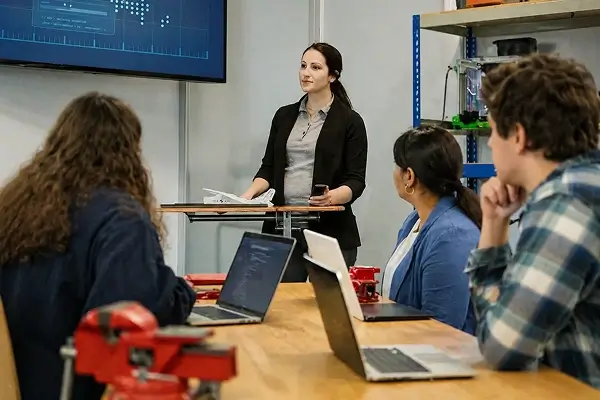
The free training program in the construction sector was designed to help participants gain practical and digital skills needed for Ukraine’s reconstruction and future employment.
The initiative focused on inclusive access to modern construction education, with priority given to internally displaced persons, veterans, persons with disabilities, and women motivated to develop professionally in the construction sector.
Program Overview
The training combined basic construction skills, digital construction tools, and sustainable building principles. Participants moved from site orientation and safety to practical work, final projects, certification, and career guidance.
Locations: Dnipro, Kharkiv, Mykolaiv
Format: Hybrid — online and offline
Initial duration: 120 hours / 4 weeks
Follow-up format: 60 hours / 2 weeks
Who the Program Served
- Internally displaced persons;
- Veterans;
- Persons with disabilities;
- Women seeking professional development in construction;
- Adults looking to retrain, upskill, or enter the construction sector.
What Participants Learned
- Basics of building materials, tools, and construction safety;
- Interior repairs, drywall, carpentry, and plumbing;
- Digital construction tools, including SketchUp, 3D scanning, and Trimble Connect;
- Energy efficiency, green and circular construction;
- Cultural heritage preservation;
- Career navigation, employment preparation, and final project work.
Learning Outcomes
After completing the training, participants were able to understand key construction processes, perform basic repair and construction work, use digital tools for modeling and coordination, and apply principles of energy-efficient and sustainable construction.
The program also helped participants form realistic professional development plans and explore opportunities for entering the construction industry.
Hands-On Training with Milwaukee Tool
As part of the program, participants in Mykolaiv, Kharkiv, and Dnipro took part in practical workshops with Milwaukee Tool. These hands-on days became one of the strongest elements of the training.
The workshops followed a “from theory to real work” approach. Participants first learned about modern technological solutions and then moved directly into intensive practice with professional tools.
- Participants performed drilling and fastening on different surfaces;
- Practiced cutting accuracy using cordless saws;
- Worked with M18 and M12 battery systems;
- Tested tools in conditions close to real construction work;
- Learned about safe tool operation and correct equipment selection.
This practical experience helped participants build confidence, understand how to work with different materials, and see construction as a modern, technological, and accessible profession.
First Stage Results
The first stage of the program was successfully implemented in January–February 2026 in Mykolaiv, Kharkiv, and Dnipro.
- 115 participants joined the training;
- 111 participants successfully completed the program and received certificates;
- Up to 100% completion was achieved in the second cohort;
- 60–61% of participants were women;
- About 70% of participants were open to employment after the course.
The first stage proved the effectiveness of a model that combines reskilling, upskilling, practical construction training, and digital technologies.
Second Training Wave
Following the successful first stage, a new wave of the program was launched in March 2026 in Kharkiv and Mykolaiv.
This stage was adapted to a more intensive format:
- Duration: 60 hours / 2 weeks;
- Format: Hybrid — online and offline;
- Focus: practical construction skills, digital tools, and employment readiness.
The training remained accessible and inclusive, with priority given to women, internally displaced persons, veterans, and persons with disabilities.
Second Stage Results
The second stage confirmed that the training model can scale effectively and deliver results even in a compressed format.
- 38 participants took part, exceeding the planned target of 30;
- 100% of participants successfully completed the training and received certificates;
- More than 50% of participants were women;
- The majority of participants were internally displaced persons;
- Participants gained practical skills that can be applied immediately after training.
The cohort included both newcomers without construction experience and participants with technical or working backgrounds. This confirmed the program’s value for both entry-level training and upskilling.
Social and Market Impact
The program became more than a training opportunity. It supported social adaptation, confidence-building, and professional reintegration for people affected by war and displacement.
Participants formed new professional contacts, gained confidence working with tools and digital technologies, and developed a clearer understanding of how they could contribute to Ukraine’s reconstruction.
The program also helped connect participants with construction industry stakeholders and potential employment opportunities.
Strategic Importance
The results confirmed the need for practical, inclusive, and technology-focused training models in Ukraine’s reconstruction sector.
By combining hands-on construction work, digital tools, sustainable building principles, and career support, the program created a pathway for rapid retraining and professional development.
This is not just training — it is a practical step toward preparing people to take part in rebuilding Ukraine.
Program Partners
The training is organized and implemented by Swisscontact with financial support from the UK government through UK aid within the framework of the BLOOM Programme.
The programme is implemented by the BLOOM consortium, which includes Mercy Corps, the International Rescue Committee, Swisscontact, and Right to Protection.
The project is implemented through HERZ Construction Association LLC in collaboration with EAUA, Educational Alliance for Ukraine, and local educational institutions in Mykolaiv, Kharkiv, and Dnipro.